Role-Based CUI Responsibilities (Mapped to Real Jobs)
Executives, PMs, engineers, HR, finance, IT, procurement — who owes what.
About this guide
A CUI program only works when every role knows exactly which slice it owns. 'Someone else is checking the markings' is the single most expensive sentence in CUI compliance.
This guide translates the abstract language of 32 CFR 2002, NIST SP 800-171, and DoD policy into a concrete responsibility matrix mapped to the actual jobs on your org chart.
“After an audit, the only question that matters is 'Whose job was this?' — name the someone, in writing, before you need to.”
What you'll learn
- ✓What executives actually owe a CUI program — beyond signing the policy.
- ✓How PMs run weekly 'purple sweeps' that catch issues before audits do.
- ✓Where engineering, HR, finance, IT, and procurement each touch CUI.
- ✓How to draft a RACI matrix every employee can find in 30 seconds.
- ✓How to flow CUI requirements down to subcontractors and verify them.
- ✓How to retire 'someone else is checking it' as a cultural default.
Inside this guide
- 01
Chapter 1 — Executive sponsors
Policy ownership, funding, and the senior official accountable for CUI.
- 02
Chapter 2 — Project managers
Weekly purple sweeps, new-joiner briefings, compliance-as-design.
- 03
Chapter 3 — Engineering
Drawings, code repos, build artifacts, supplier packages.
- 04
Chapter 4 — HR & people ops
Privacy CUI handoffs that frequently leak.
- 05
Chapter 5 — Finance & procurement
Source-selection, sealed bids, supplier pricing, flow-down clauses.
- 06
Chapter 6 — IT & security
Tooling, encryption, access, monitoring, and incident response.
- 07
Appendix — Sample RACI matrix
Lift directly into your own program documentation.
Who it's for
- •Executives accountable for the CUI program.
- •PMs and team leads running day-to-day compliance.
- •Engineers, HR, finance, IT, and procurement contributors.
- •Security officers building an internal RACI.
Key takeaways
- →Every CUI activity has a named owner — in writing.
- →Compliance is the path of least resistance, not a stick.
- →Near-misses are reported, not punished.
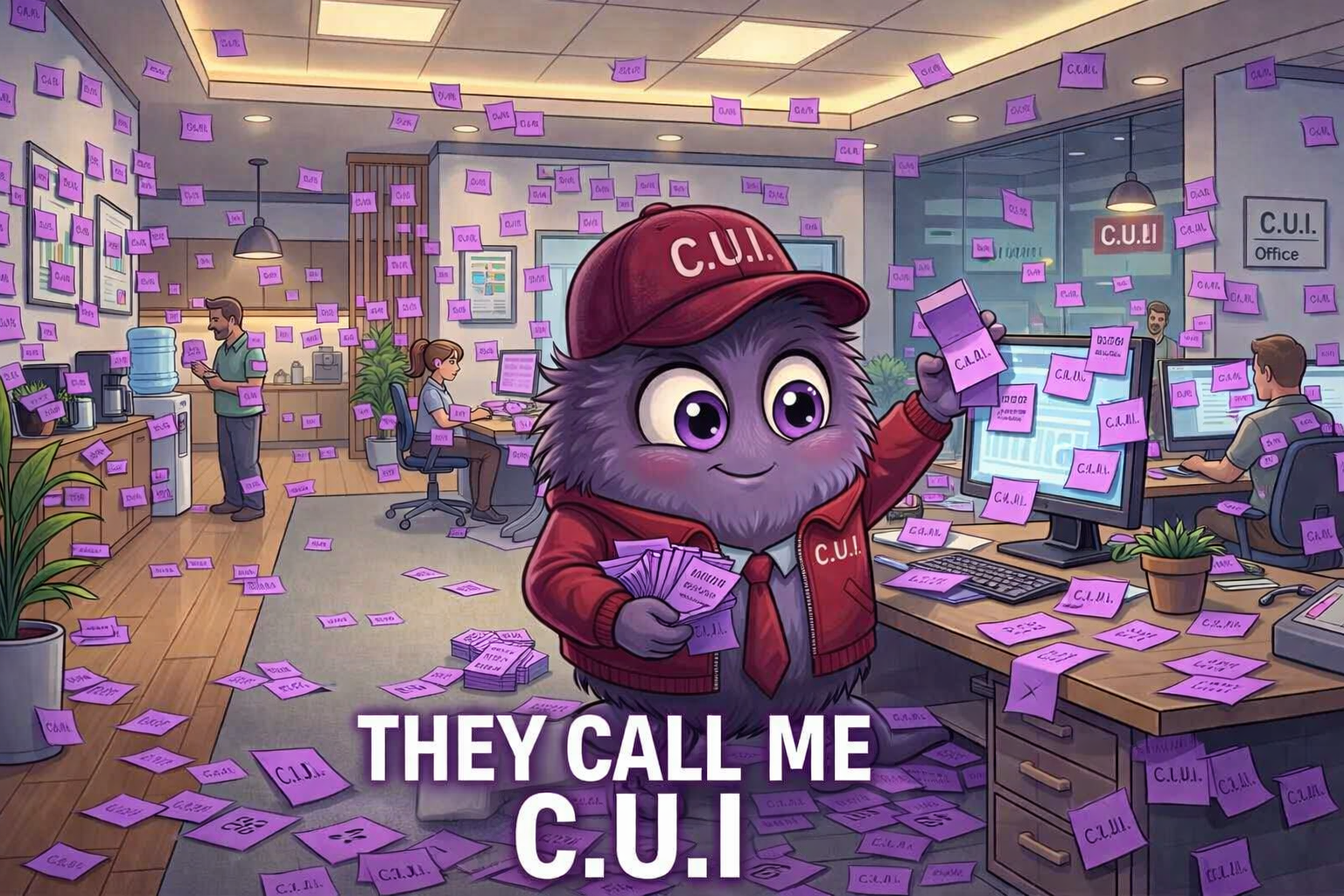
Parabl says: 'someone else is checking the markings' is the most expensive sentence in CUI. Name the someone.
CUI compliance is a team sport. Every role has a slice of the responsibility, and the program only works when each role plays its part.
Executive sponsors
Own the program. Resource it. Sign the policy. When leadership cites the rules, the rest of the org follows.
Project managers & team leads
Set the culture. Run weekly purple sweeps. Make compliance the path of least resistance for the team.
Engineers
Mark every artifact you create. Apply markings to drawings, code repos, build artifacts, supplier packages.
HR & people ops
Privacy CUI is your home turf — personnel files, background checks, accommodations. Lock the handoffs.
Finance & procurement
Source selection, sealed bids, supplier pricing all live in CUI//PROCURE. Flow CUI requirements down to subcontractors.
IT & security
Provision approved tools, enforce encryption, gate access, monitor for anomalies. Make the secure path the easy path.
Do
- ✓ Define ownership in writing — every artifact has a responsible role.
- ✓ Confirm team training is current each quarter.
- ✓ Audit flow-down compliance with suppliers each quarter.
- ✓ Publish a RACI matrix every employee can find in 30 seconds.
Don't
- ✗ Assume 'someone else' is checking the markings.
- ✗ Punish the person who reports a near-miss.
- ✗ Let executive policies sit unsigned for months.
Take it further
This guide is managed and controlled. Our team reviews each request and sends the guide via email.
More guides
CUI Labeling & Banner Marking Guide (2026 Edition)
Banners, portion marks, dissemination controls — done right.
CUI Categories & Subcategories Explained
Basic vs. Specified, authority citations, registry interpretation.
CUI Handling Rules for Everyday Employees
Storage, sharing, destruction, travel, remote work — the daily playbook.