Quick Insights

Quick Insights

Clarity, right when you need it.

This is your fast lane to understanding Role-Based Training, CUI workflows, and how ParablAI turns compliance chaos into clarity. Real questions. Real scenarios. Real solutions.

Showing 11 of 11 insights
What is Role-Based Training?
Role-Based Training
Insight 01

What is Role-Based Training?

Scenario

A company thinks annual cybersecurity training is enough but discovers CMMC requires role-specific instruction.

Fast Answer

Role-Based Training means each employee must be trained on the CUI-related tasks tied to their job role.

Insight

Generic, once-a-year cybersecurity training was built for awareness — not for the operational reality of handling Controlled Unclassified Information. Auditors under CMMC and NIST 800-171 expect to see that each person has been trained on the specific tasks, systems, and CUI touchpoints tied to their role. When a payroll clerk, an engineer, and a system admin all sit through the same slide deck, none of them actually learn what they're responsible for. Role-Based Training (RBT) flips this. It starts with the role, maps it to the CUI workflow, and trains the human on exactly what they do. It's the foundation every other CMMC control quietly leans on — and the first thing assessors pull on when they want to see if your program is real.

How ParablAI Solves This
  • Generates role definitions
  • Maps CUI workflows
  • Creates role-specific micro training
  • Issues certificates and evidence logs

#RBT#CMMC#Foundations
Share this insight
Email SMS
How Can I Meet the Controls for Role-Based Training?
Compliance Basics
Insight 02

How Can I Meet the Controls for Role-Based Training?

Scenario

A compliance lead is overwhelmed by the ambiguity of 'role-based' requirements.

Fast Answer

You meet RBT controls by mapping roles to CUI workflows and training each person on their responsibilities.

Insight

The control language around RBT (NIST 800-171 3.2.2, CMMC AT.L2-3.2.2) is intentionally outcome-driven: train personnel on the security responsibilities of their assigned role. That ambiguity is where most programs fail. They produce a generic LMS report and hope it's enough. Assessors want three artifacts: a role inventory tied to CUI, a documented training plan per role, and evidence the training happened — completions, timestamps, content covered. The common failure isn't missing training; it's missing the link between the role, the workflow, and the evidence. Closing that gap is straightforward when the system is designed around roles instead of courses, and when evidence is generated as a byproduct of training rather than chased after the fact.

How ParablAI Solves This
  • Auto-builds role matrices
  • Creates workflow diagrams
  • Generates training and quizzes
  • Produces evidence logs
#Controls#NIST 800-171#CMMC
Share this insight
Email SMS
Benefits of Role-Based Training
Role-Based Training
Insight 03

Benefits of Role-Based Training

Scenario

Leadership questions why RBT matters.

Fast Answer

RBT ensures your people know your business as well as you do.

Insight

RBT isn't a compliance line item — it's an operating system for your workforce. When every role has a documented workflow and a training path tied to it, you reduce the risk of mishandled CUI, shrink the gap between senior operators and new hires, and stop relying on tribal knowledge that walks out the door at every resignation. Leadership gets clarity on who is responsible for what. Auditors get evidence on demand. And the team itself gets confidence: they know exactly what their role is, what they're allowed to touch, and how to escalate when something looks wrong. That kind of clarity is what separates a mature security program from a binder full of policies nobody reads.

How ParablAI Solves This
  • Turns tribal knowledge into workflows
  • Creates repeatable training
  • Ensures every role is aligned
#Leadership#ROI#Operations
Share this insight
Email SMS
Preparing the Plan & Scope
Compliance Basics
Insight 04

Preparing the Plan & Scope

Scenario

A company doesn't know where to start.

Fast Answer

Start by defining roles, responsibilities, and CUI touchpoints.

Insight

Scoping is where most RBT programs live or die. Teams either try to train everyone on everything — burning time and budget — or they scope so tightly that real CUI handlers get missed. The right move is to start with a role inventory: every position, contractor, and shared account that exists. Then overlay CUI: what data enters the business, where it lives, who touches it, and where it leaves. The intersection of those two lists is your RBT scope. Everything else is general awareness. Done correctly, scoping takes a 50-person company from 'train everybody' to a focused list of 12 roles that actually drive CMMC posture — and a defensible reason why the others are out of scope.

How ParablAI Solves This
  • Auto-generates role inventories
  • Maps CUI flows
  • Creates a training plan
#Scoping#Planning#Getting Started
Share this insight
Email SMS
Process Mapping for Evidence
Evidence
Insight 05

Process Mapping for Evidence

Scenario

An auditor asks for evidence of how CUI moves through the business.

Fast Answer

You need a documented workflow showing who touches CUI and when.

Insight

When an assessor asks 'show me how CUI moves,' a sentence isn't enough and a Visio diagram from two years ago isn't either. The artifact that earns trust is a current, role-anchored workflow: ingress → handling steps → storage → egress, with the role responsible for each step and the control that governs it. Most companies have this knowledge — it just lives in one operator's head. The gap between that operator and an auditor-ready packet is documentation discipline. Process maps make implicit knowledge explicit, surface handoff risks (the moments CUI changes hands and accountability blurs), and become the spine of your evidence pack. Without them, every other piece of evidence floats in isolation.

How ParablAI Solves This
  • Generates workflow diagrams
  • Creates evidence packets
  • Produces auditor-ready exports
#Evidence#Workflows#Audit
Share this insight
Email SMS
Training & Evidence Output
Training Outputs
Insight 06

Training & Evidence Output

Scenario

A company can't prove training happened.

Fast Answer

You need logs, timestamps, certificates, and role alignment.

Insight

'We trained them' is not evidence. An assessor needs to see, per person: which role they were trained for, what content they covered, when they completed it, what they scored on knowledge checks, and a certificate tied back to that record. A spreadsheet of names doesn't survive scrutiny. Neither does a generic LMS export that lists 'Cybersecurity 101' without role context. Real evidence is generated as a byproduct of training itself — issued the moment a learner completes a role-specific module, timestamped server-side, and stored in a way that can be filtered by role, date range, or framework. That's the difference between scrambling the week before an audit and pulling a packet in under a minute.

How ParablAI Solves This
  • Issues certificates
  • Logs completions
  • Stores evidence
#Evidence#Certificates#Reporting
Share this insight
Email SMS
How Do I Know Which Roles Need Training?
Role-Based Training
Insight 07

How Do I Know Which Roles Need Training?

Scenario

A company has 40 employees and no clarity on who handles CUI.

Fast Answer

Any role that touches CUI or supports CUI systems requires RBT.

Insight

There are two tiers worth knowing. Tier one: anyone who directly creates, receives, processes, stores, or transmits CUI. Engineers on DoD programs, contracts staff handling DD-254s, IT admins of CUI systems — they need full RBT. Tier two: support roles that touch CUI-adjacent systems. Help desk, facilities with access to secure areas, finance running invoices that reference CUI projects. They need scoped training on the parts they interact with, not the whole stack. Everyone else gets general security awareness and a clear rule: don't touch what you're not trained for. The mistake is treating all 40 people as one bucket. The cure is a role-by-role risk read that takes an afternoon, not a quarter.

How ParablAI Solves This
  • Auto-detects CUI roles
  • Generates role descriptions
  • Assigns training
#Roles#CUI#Risk Tiers
Share this insight
Email SMS
What Does a Role-Based Training Plan Look Like?
Training Outputs
Insight 08

What Does a Role-Based Training Plan Look Like?

Scenario

A company wants a template.

Fast Answer

A good RBT plan includes roles, workflows, training modules, and evidence.

Insight

A real RBT plan is four sections that fit on a single page each. One: the role inventory — every role in scope, with a one-line CUI responsibility statement. Two: the workflow per role — the CUI tasks they perform and the controls those tasks satisfy. Three: the training assignment — which modules each role must complete, the cadence (onboarding, annual, on-change), and the knowledge-check threshold. Four: the evidence — where completions are stored, how certificates are issued, and how the plan is reviewed. Templates fail when they're generic. Plans win when they're specific to your roles, your CUI, and your systems — and when they're regenerated as those things change instead of frozen in a PDF.

How ParablAI Solves This
  • Generates full RBT plans
  • Creates modules
  • Produces evidence
#Templates#Planning#RBT
Share this insight
Email SMS
How Do I Train Non-Technical Staff?
Role-Based Training
Insight 09

How Do I Train Non-Technical Staff?

Scenario

HR, finance, or admin staff feel overwhelmed.

Fast Answer

Train them on the CUI touchpoints relevant to their role only.

Insight

Non-technical staff don't need to understand FIPS-validated cryptography. They need to know: which emails contain CUI, what to do when one lands in their inbox, who in the company is authorized to handle it, and how to escalate without making things worse. Training that opens with acronyms loses them in the first minute. Training that opens with a scenario from their actual workday — a vendor invoice referencing a CUI project number, an HR file requested by a program manager — earns attention and sticks. Keep modules under ten minutes, use plain language, focus on the three or four decisions they actually have to make, and issue a certificate that maps to their role. Done right, non-technical RBT is often your strongest compliance asset.

How ParablAI Solves This
  • Creates non-technical modules
  • Uses plain language
  • Issues certificates
#Non-Technical#HR#Finance
Share this insight
Email SMS
The 3-Step ParablAI RBT System
Trending Today
Insight 10

The 3-Step ParablAI RBT System

Scenario

A company wants a simple path.

Fast Answer

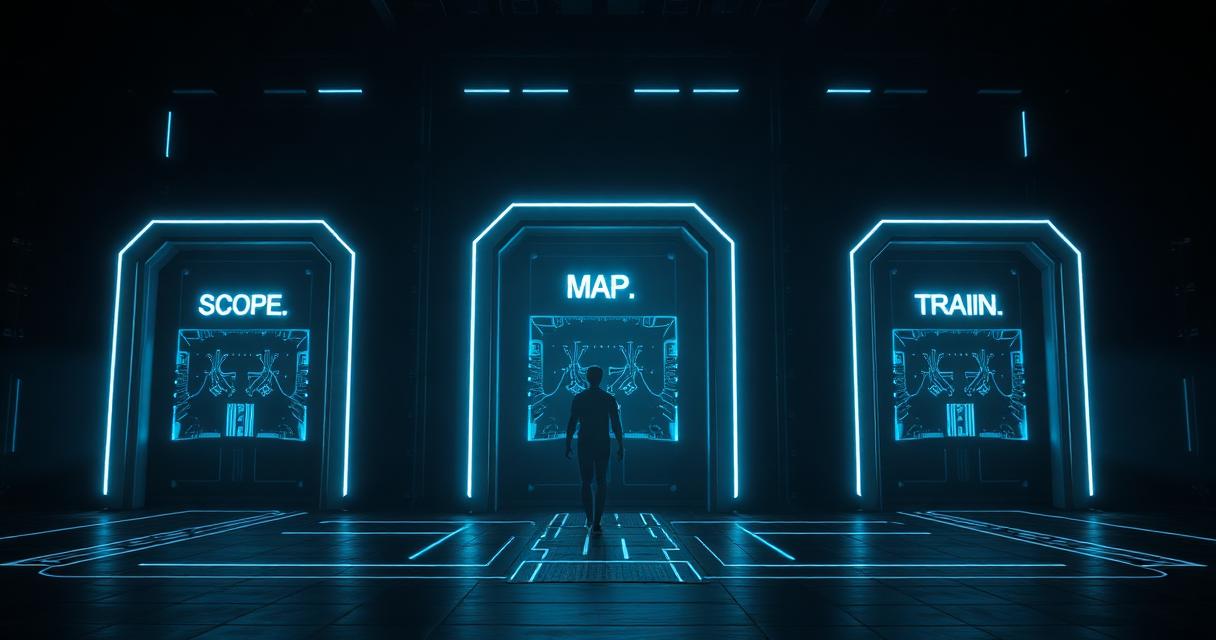
ParablAI uses a 3-step system: Scope → Map → Train.

Insight

Complex programs collapse under their own weight. Simple ones get executed. ParablAI's system is three steps because three is the number a leadership team will actually fund and a compliance team will actually run. Scope: identify every role and every CUI touchpoint, and draw the boundary. Map: turn each in-scope role into a documented workflow showing what they do with CUI and which controls govern those actions. Train: generate role-specific modules, run the team through them, capture certificates and evidence as a byproduct. Each step produces an artifact the next step consumes — so nothing has to be rebuilt, and the whole thing stays current as roles and workflows change. That's the difference between a one-time audit prep and a living program.

How ParablAI Solves This
  • Step 1: Scope roles and CUI
  • Step 2: Map workflows
  • Step 3: Train and certify
#System#Methodology#Trending
Share this insight
Email SMS
How many frameworks require Role-Based Training?
Trending Today
Insight 11

How many frameworks require Role-Based Training?

Scenario

A compliance lead assumes Role-Based Training is only a CMMC requirement — until a SOC 2 audit, an ISO 27001 gap assessment, and a FedRAMP scoping call all surface the same expectation in different language. Suddenly 'CMMC training' is a multi-framework problem.

Fast Answer

At least 6 major frameworks require Role-Based Training directly or implicitly, and ParablAI can generate compliant training for all of them.

Insight

RBT is no longer a CMMC quirk — it's the default expectation across modern frameworks. Explicit requirements: NIST SP 800-16 (role-based training program guidance), NIST SP 800-181 / NICE (a full workforce role taxonomy), NIST SP 800-53 AT-2 and AT-3 (awareness plus role-based training), CMMC Level 2 (inherited from 800-171 3.2.2), and ISO 27001 A.6.3 and A.7.2 (competence and awareness by role). Implicit requirements: SOC 2 CC1.4 and CC2.2 lean on role-aligned competence and communication, and FedRAMP pulls 800-53's AT family in directly. Auditors across all of these ask the same three things: which roles touch the data, what each role was trained on, and where the evidence lives. Generic annual training answers none of those. Role-aligned training answers all three at once — which is why every framework is converging on it.

How ParablAI Solves This
  • Generates role definitions for any framework
  • Maps CUI and data workflows automatically
  • Creates role-specific micro training modules
  • Issues certificates, logs, and timestamps
  • Produces auditor-ready evidence packets
  • Supports multi-framework alignment in one system
#CMMC#NIST#ISO 27001#SOC 2#FedRAMP#Trending
Share this insight
Email SMS

Ready to turn insight into action?

Generate your first role, map your CUI workflow, and produce audit-ready evidence in minutes.